
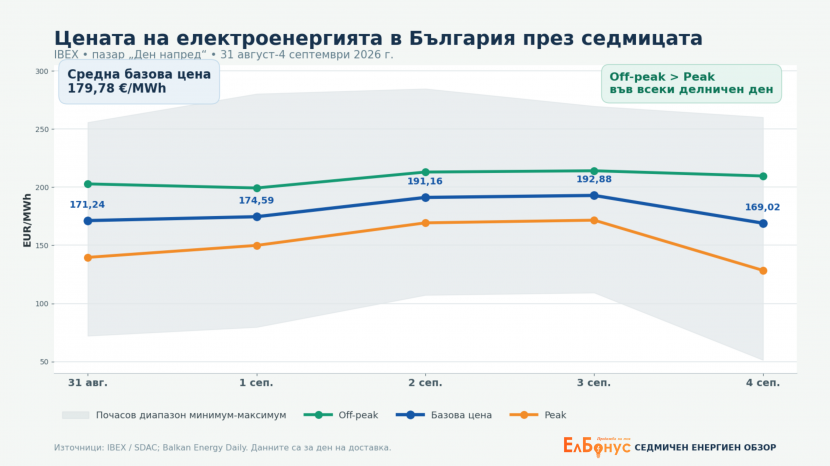
The average baseload price on the Independent Bulgarian Energy Exchange reached €179.78/MWh over the period from 31 August to 4 September. Despite the recovery in nuclear generation in Bulgaria and Hungary, the continued outage of Romania’s Cernavodă NPP, weak hydrological conditions and expensive replacement generation kept electricity prices across Southeastern Europe high.
The Week in Numbers
The IBEX baseload price started the week at €171.24/MWh and increased consecutively to €174.59/MWh on Tuesday, €191.16/MWh on Wednesday and €192.88/MWh on Thursday. On Friday, it declined to €169.02/MWh.
The highest hourly price of the week was €284.70/MWh in H20 on 2 September. The lowest price was €51.30/MWh in H10 on 4 September.
The difference between the various parts of the day was particularly significant. The average peak price over the five working days was €151.76/MWh, while the average off-peak price reached €207.76/MWh. This represents a difference of €56/MWh, or approximately 36.9%.
This confirms that the main price pressure remained concentrated outside the hours of strong photovoltaic generation, particularly after sunset.
Kozloduy NPP Restored Its Output
Following the precautionary reduction implemented in August, the output of Unit 5 at Kozloduy NPP was gradually increased. Actual nuclear generation in Bulgaria reached approximately 1,829 MW on 3 September.
The recovery improved Bulgaria’s electricity balance but did not result in a significant reduction in the market price. Bulgaria continued to generate more electricity than it consumed, while net exports remained at or above approximately 1 GW during the final days of the week.
This indicates that the high IBEX price was not caused by a physical shortage of electricity in Bulgaria. Instead, it resulted from the overall supply-demand balance and the marginal price across the interconnected regional market.
Romania Remained Without Nuclear Generation
The main regional risk continued to be Romania’s Cernavodă NPP. Its two reactors, which under normal operating conditions provide approximately 20% of the country’s electricity, remained offline because of the low water level of the Danube.
Romania ended the week with zero nuclear generation and an increased need for electricity imports. Forecast net imports for 4 September reached 1,227 MW, with a significant proportion of the flow supplied by Bulgaria.
The Romanian authorities are preparing a three-stage emergency plan to secure the plant’s water supply. The proposed measures include redirecting the river flow using loaded vessels and barges, constructing a temporary barrier and deploying high-capacity pumps.
The primary objective of these measures is to maintain safe cooling conditions. The reactors’ return to operation remains dependent on hydrological conditions and is not currently expected before 10 September.
Paks NPP Recovered, but Hungary Remained Expensive
Nuclear generation in Hungary also recovered following the restrictions caused by the low water level of the Danube. On 3 September, output from Paks NPP reached approximately 1,845 MW — close to the plant’s nominal capacity.
Despite this recovery, the Hungarian market remained among the most expensive in the region. For 4 September, the HUPX baseload price was €179.78/MWh, compared with €175.92/MWh in Romania and €169.02/MWh in Bulgaria.
This demonstrates that restoring individual power plants is not sufficient to immediately normalise prices while the region continues to experience a shortage of affordable and flexible generation.
Higher Renewable Generation Lowered Friday’s Daytime Price
The IBEX baseload price declined by 12.37% on Friday. A key factor was the stronger regional forecast for renewable generation: solar output increased by approximately 1,154 MW and wind generation by around 318 MW compared with the previous day.
However, the effect was concentrated mainly during daylight hours. The peak price fell from €171.60/MWh to €128.40/MWh, while the off-peak price declined only marginally, from €214.10/MWh to €209.60/MWh.
The evening hourly price remained high, reaching €260.20/MWh in H21. Therefore, higher solar and wind generation can reduce the average daily price, but it does not resolve the challenge of meeting demand after sunset.
Gas and Emission Allowance Prices Kept Replacement Generation Expensive
The CEGH gas price reached €74.86/MWh on 3 September before declining slightly to €73.69/MWh on Friday. The price of EU carbon allowances remained above €83 per tonne.
These price levels increase the generation costs of gas- and coal-fired power plants. When part of the more affordable nuclear and hydropower generation is unavailable, these plants frequently set the marginal electricity market price.
Regional market coupling spreads this effect across Bulgaria, Romania, Hungary, Greece, Croatia and Slovenia. On 4 September, the IBEX baseload price remained €80.07/MWh above the German market, where the baseload price fell to €88.95/MWh.
Outlook for the Following Week
El Bonus’ base-case scenario is for a partial easing of average daily electricity prices, provided that solar and wind generation remains sufficient and there is no renewed increase in temperatures.
However, we do not expect the evening price risk to disappear on a sustained basis. If both units at Cernavodă NPP remain offline and gas prices stay elevated, the hours after sunset could once again experience sharp price increases.
The restored capacity at Kozloduy NPP and Paks NPP reduces the risk to the regional electricity balance, but it cannot fully offset the missing Romanian nuclear generation, weak hydrological conditions and the limited capacity to shift daytime solar generation to the evening hours.
Important Notice
The expectations presented in this publication constitute El Bonus’ own market analysis, prepared on the basis of the information currently available, observed market trends and certain assumptions. This material is provided solely for informational purposes and does not constitute a guarantee of future price movements, individual advice or an offer to enter into any transaction.
Actual market developments may differ substantially from the scenario described. Any trading or management decision should be made following an independent assessment. El Bonus accepts no liability for decisions based solely on this publication.
Sources
Independent Bulgarian Energy Exchange — https://ibex.bg/
Kozloduy NPP — https://www.kznpp.org/bg/novini/679
Bulgarian Electricity System Operator — https://www.eso.bg/
Information on the emergency plan for Cernavodă NPP — https://seenews.com/news/romania-sets-phased-plan-to-secure-water-supply-for-cernavoda-npp-1300607
Information on the expected restart date for Cernavodă NPP — https://www.romaniajournal.ro/business/companies/energy/cernavoda-nuclear-plant-may-delay-reopening-until-september-10/
Information on the recovery of Paks NPP — https://www.enerdata.net/publications/daily-energy-news/paks-nuclear-plant-2-gw-returns-full-capacity-after-record-low-danube-levels.html