
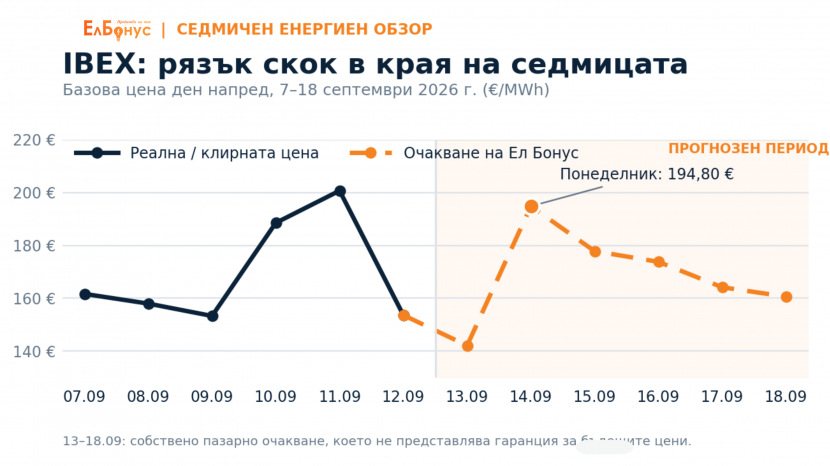
The average baseload price on the Independent Bulgarian Energy Exchange reached €172.42/MWh for the period from 7 to 11 September. After the week began with lower price pressure, IBEX rose sharply towards the end of the period and reached €200.66/MWh on Friday.
The main drivers were the recovery in consumption following the holiday Monday, higher residual load, weaker wind and solar generation, rising gas prices and the continued unavailability of Romania’s Cernavodă Nuclear Power Plant.
The Week in Numbers
The IBEX baseload price started the week at €161.65/MWh, declined to €157.98/MWh on Tuesday and €153.31/MWh on Wednesday, and then increased to €188.50/MWh on Thursday and €200.66/MWh on Friday.
The lowest hourly price in the consistent daily series used for this analysis was €20.20/MWh, while the highest was €301.40/MWh.
The difference between the various parts of the day remained particularly significant. The average peak price for the five business days was €141.06/MWh, while the average off-peak price reached €203.80/MWh.
The spread of €62.74/MWh, or approximately 44.5%, shows that price pressure remained concentrated outside the hours of strong solar generation, particularly after sunset.
From Holiday Demand to High Residual Load
Monday, 7 September, was a non-working day because Bulgaria’s Unification Day public holiday fell on a Sunday in 2026. This contributed to lower consumption and lower price pressure at the beginning of the week.
By Friday, the situation had changed substantially. Residual load — the consumption that must be covered after renewable generation has been deducted — increased from approximately 26.8 GWh to 44.4 GWh, or by around 65%. Consumption recovered, while solar generation weakened on Friday compared with the previous days.
This shift explains why prices increased sharply even though Bulgaria’s domestic generation balance did not deteriorate materially during the week.
Higher Gas Prices Amplified the Regional Move
The regional CEGH gas index rose from €72.61/MWh on Monday to €83.17/MWh on Friday, an increase of approximately 14.5%. The price of EU carbon allowances also remained high at around €85.82/t.
When residual load rises and wind and solar generation decline, the market relies more heavily on gas- and coal-fired power plants. The higher operating costs of these units are reflected in the marginal electricity price.
The increase was not limited to Bulgaria. On Friday, the baseload price reached €208.98/MWh in Hungary and €208.46/MWh in Romania.
Bulgaria Remained a Strong Net Exporter
Actual nuclear generation in Bulgaria on 10 September was approximately 1,835 MW. Total generation reached around 5,004 MW, compared with consumption of 3,327 MW, while net exports stood at approximately 1,678 MW.
These figures show that the high IBEX price was not caused by a physical shortage of electricity in Bulgaria. Kozloduy NPP was operating steadily, and the country generated substantially more electricity than it consumed.
Prices are formed within an interconnected regional market. When neighbouring systems face a shortage of lower-cost baseload and flexible generation, the effect is transmitted to Bulgaria through cross-border flows and the regional marginal price.
Cernavodă Remained a Regional Risk Factor
Romania continued to report zero nuclear generation from Cernavodă NPP. Its two reactors normally supply approximately one-fifth of the country’s electricity. Their unavailability increases the need for thermal generation and imports, including supplies from Bulgaria.
The missing Romanian nuclear capacity is not the sole reason for the high prices, but it amplifies the effects of expensive gas, weak hydrological conditions and lower wind generation. The stable operation of Kozloduy NPP is not sufficient on its own to offset this broader regional pressure.
Imbalance Prices Highlighted the Risk of Unscheduled Solar Surplus
ESO’s provisional data show that the average imbalance price remained below the average day-ahead market price between 7 and 10 September. At the same time, midday minimum prices fell to −€299.00/MWh on 8 September and −€392.37/MWh on 9 September.
These values demonstrate that an unscheduled surplus during periods of strong solar generation can produce an extremely adverse financial outcome. The widening spread between low midday prices and expensive evening hours increases the value of accurate forecasting, demand-side management and energy storage systems.
Outlook for 12–18 September
Saturday, 12 September, has already cleared at an average price of €153.64/MWh, with a midday minimum of €5.00/MWh. Our base-case scenario for Sunday is for price pressure to remain lower.
For the business days from 14 to 18 September, we expect an average price of around €174.23/MWh — close to the level recorded during the previous week, but with pronounced volatility within the period.
Monday is expected to be the highest-risk day. Our base-case scenario indicates an average price of approximately €194.80/MWh, with a possible evening maximum close to €328/MWh. A gradual decline towards the €160–178/MWh range is expected thereafter, although evening prices may remain elevated, with forecast highs of approximately €269–291/MWh.
The main risks to this scenario are movements in gas prices, actual wind and solar generation, residual load and the duration of the Cernavodă NPP outage.
Important Notice
The expectations presented above constitute El Bonus’s own market analysis, prepared on the basis of the information currently available, observed market trends and certain assumptions. This material is provided for informational purposes only and does not constitute a guarantee of future price movements, an individual recommendation or an offer to enter into a transaction.
Actual market developments may differ materially from the scenario described. Any trading or management decision should be made following an independent assessment. El Bonus accepts no liability for decisions based solely on this publication.
Sources:
Independent Bulgarian Energy Exchange — IBEX
Electricity System Operator — ESO
Official public holidays in Bulgaria — Council of Ministers
Reuters — European gas and energy market context
Associated Press — shutdown of Cernavodă’s second reactor
SEE+Hungary Energy Daily, issues dated 7–11 September 2026